

From Compliance to Conscience: A Research Journey into Righteousness Corporate Governance
Sharing Research, Resources, and Reflections – Sunil Khandbahale
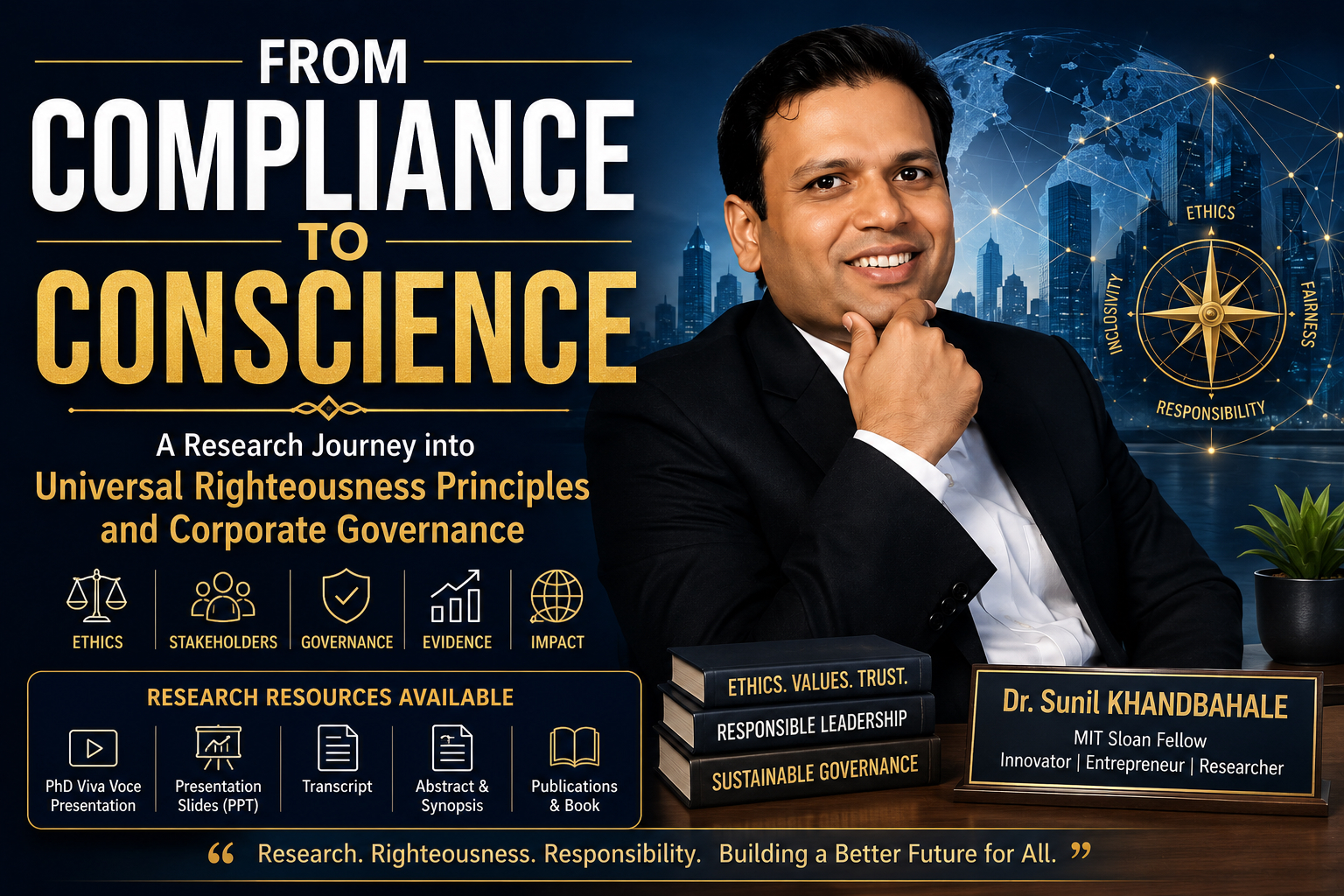
Research creates its greatest value when it moves beyond publication and begins influencing thought, practice, policy, and society.
After completing my doctoral research and successfully defending my PhD Viva Voce, I received numerous requests from research scholars, students, academicians, industry professionals, and friends asking whether I could share my presentation, transcript, methodology, and research resources.
In the spirit of academic transparency, knowledge sharing, and collaborative learning, I have decided to make several components of my doctoral journey publicly accessible.
My intention is simple: if these resources can help even one researcher refine a methodology, one student gain confidence, one organization adopt a more evidence-based approach, or one policymaker reflect on governance differently, then the years invested in this research will have created value beyond the boundaries of a thesis.
I view this research not as an endpoint, but as the beginning of a broader conversation on ethics, governance, leadership, and human values in contemporary organizations.
Research at a Glance
Research Title
Impact of Universal Righteousness Principles (URP) on Corporate Governance in IT-Based Multinational Organizations
University
Savitribai Phule Pune University (SPPU), Pune, India
Research Period
2022–2026
Research Domain
Corporate Governance, Business Ethics, Leadership, Organizational Behavior, Stakeholder Management, and Interdisciplinary Governance Studies
Research Approach
Mixed-Methods Research
Key Variables
- Universal Righteousness Principles (URP)
- Corporate Governance (CG)
- Stakeholder Loyalty
- URP Awareness
The Question That Started It All
Many governance frameworks successfully address compliance, regulation, risk management, and accountability. Yet despite increasingly sophisticated systems, corporate scandals continue to emerge across industries and geographies.
This observation led me to a fundamental question:
Is compliance alone sufficient to ensure ethical governance?
Or perhaps more importantly:
What makes governance itself righteous?
As I explored this question through literature, professional experience, and conversations with experts, I discovered a recurring theme.
Organizations often possess policies, procedures, and controls. However, the effectiveness of these mechanisms ultimately depends upon the values, awareness, intentions, and decisions of human beings.
This realization gradually shaped the foundation of my research and inspired the exploration of Universal Righteousness Principles (URP) as a potential contributor to stronger and more meaningful corporate governance.
Why Universal Righteousness Principles?
The concept of Universal Righteousness Principles emerged from extensive qualitative exploration involving expert interviews, thematic analysis, and interdisciplinary study.
The research sought to identify ethical principles that transcend geography, religion, culture, organizational hierarchy, and professional discipline.
The objective was not to advocate a particular ideology but to explore whether universally accepted values such as ethics, accountability, fairness, responsibility, inclusivity, integrity, and stakeholder consciousness could strengthen governance outcomes.
The resulting construct was conceptualized as Universal Righteousness Principles (URP).
Research Methodology
The study adopted a sequential mixed-methods approach.
Phase 1: Qualitative Research
- In-depth interviews with more than 150 experts
- Representation across 39 professional designations
- Thematic analysis of interview data
- Identification and conceptualization of URP dimensions
Phase 2: Quantitative Research
- Study of 24 IT-based multinational organizations
- Analysis of more than one million stakeholder observations, ratings, surveys, and reviews
- Descriptive statistics
- Correlation analysis
- Regression analysis
- ANOVA
Phase 3: Intervention and Case Study
- Design and implementation of a URP Awareness Program
- Pre- and post-intervention assessments
- Evaluation using paired t-tests and comparative analysis
Phase 4: Framework Development
- Integration of qualitative findings
- Integration of quantitative evidence
- Development of the URP-Driven Corporate Governance Framework
Key Research Contributions
The research produced several noteworthy outcomes.
1. Conceptualization of Universal Righteousness Principles
A structured and measurable framework was developed to understand how ethical awareness and value-based decision-making can influence governance.
2. Empirical Validation
The study demonstrated statistically significant relationships between Universal Righteousness Principles and Corporate Governance.
3. Stakeholder Loyalty
Findings indicated that stronger adherence to Universal Righteousness Principles contributes positively to stakeholder trust and loyalty.
4. Awareness Matters
The research demonstrated that deliberate awareness-building interventions can significantly improve ethical understanding and governance effectiveness.
5. URP-Driven Governance Framework
A practical framework was developed to support organizations seeking to move beyond compliance toward more conscious, responsible, and stakeholder-centric governance.
Research Resources
To support fellow researchers, students, educators, and practitioners, the following resources are being shared publicly.
PhD Viva Voce Presentation
Watch Video:
[YouTube Link: https://youtu.be/rbvHsGbuVPg?si=w5zN0iLyhoiYQ51O]
Presentation Slides (PDF)
Watch Slides:
Presentation Transcript
Download:
Research Abstract
Research Synopsis
Research Publications
Emerald Publishing: https://www.emerald.com/eemcs/article-abstract/doi/10.1108/EEMCS-05-2024-0212/1246048/Boardroom-crossroads-CEO-prosecution-vs-bank
Ivey Publishing: https://www.iveypublishing.ca/s/product/google-the-nimbus-protests-a-governance-challenge/01tOF0000080r4YYAQ
Google Scholar: https://scholar.google.com/citations?user=f0q3EqkAAAAJ&hl=en&oi=ao
SSRN: Social Science Research Network https://papers.ssrn.com/sol3/cf_dev/AbsByAuth.cfm?per_id=6750045
Book
Corporate Governance Essentials: From Theory to Practice
Eliva Publishing: https://www.elivapress.com/en/book/book-2084333956/
Amazon Publishing: https://www.amazon.in/dp/B0F1G5G5RY
Courses and Learning Resources
Udemy Course: Workplace Culture: https://www.udemy.com/course/workplace-culture/
Udemy Course: Corporate Governance Essentials: https://www.udemy.com/course/corporate-governance-essentials-from-theory-to-practice/
OpenLearn University: Corporate Governance Essentials: https://www.open.edu/openlearncreate/course/view.php?id=12309
More Useful Resources created on CG
Workplace Culture: https://www.youtube.com/playlist?list=PLeBORb4VdktwLQlXKn786805WQucRX7Zd
Corporate Governance Toolkit: https://www.youtube.com/playlist?list=PLeBORb4Vdktwf3CpU7a6fViXEb6nvSfAP
What is Governance: https://www.youtube.com/playlist?list=PLeBORb4VdktzQr59Epu6udztBt9wQOTw7
What is Good Governance: https://www.youtube.com/playlist?list=PLeBORb4VdktzoLs2pZRlo2e5zmYzMiucj
What is Bad Governance: https://www.youtube.com/playlist?list=PLeBORb4VdktyzxUOqRd6QQiT4m630j2OK
How to establish an Ethical Governance that is Morally Right: https://www.youtube.com/playlist?list=PLeBORb4VdktzONagh5s4roNiN0xX93SBp
5 Questions about Corporate Governance: https://www.youtube.com/playlist?list=PLeBORb4Vdktykrewfzc6WO0oVD2c2eHIJ
Governance Talk: https://www.youtube.com/playlist?list=PLeBORb4VdktwlyUXtl9H1sYgXrOTswzgY
Lessons Learned During the Doctoral Journey
A doctoral journey is far more than a research project.
It is an exercise in patience, humility, intellectual discipline, and continuous learning.
Throughout this journey, I learned that meaningful research requires:
- Curiosity before conclusions
- Evidence before opinions
- Listening before interpreting
- Persistence before achievement
The process reinforced the importance of interdisciplinary thinking, methodological rigor, and the willingness to challenge assumptions.
Most importantly, it strengthened my belief that research should not remain confined to academic archives. It should contribute to better decisions, better institutions, and better outcomes for society.
Future Research Opportunities
While the present study focused on IT-based multinational organizations in Nashik, Pune, and Mumbai, numerous opportunities exist for future exploration.
Potential directions include:
- AI Governance
- ESG and Sustainability Governance
- Cross-cultural validation of URP
- Public sector governance
- Governance in startups and entrepreneurial ecosystems
- Longitudinal studies
- Governance and emerging technologies
- Human-centered organizational design
I believe these areas offer significant opportunities for researchers, institutions, policymakers, and industry leaders interested in responsible innovation and ethical governance.
An Invitation to Collaborate
The challenges facing organizations today are increasingly complex and interdisciplinary.
No single discipline, institution, or sector can address them alone.
I welcome conversations with researchers, universities, policymakers, industry leaders, professional bodies, and institutions interested in advancing responsible governance, ethical leadership, stakeholder trust, artificial intelligence governance, and human-centered innovation.
Research becomes most meaningful when it inspires dialogue, collaboration, and action.
Closing Reflection
Corporate governance has traditionally focused on systems, controls, policies, and compliance.
These remain essential.
However, the future may require us to complement compliance with conscience.
Rules tell us what we can do.
Conscience helps us decide what we should do.
If this research contributes, even in a small way, toward building organizations that are more ethical, responsible, inclusive, and trustworthy, then it will have fulfilled its purpose.
Thank you for visiting this page and for your interest in the research.
I hope the resources shared here prove useful in your own academic, professional, and leadership journey.
Comments
So empty here ... leave a comment!