
“Survival of Everyone, not Survival of the Fittest”— Sunil KHANDBAHALE
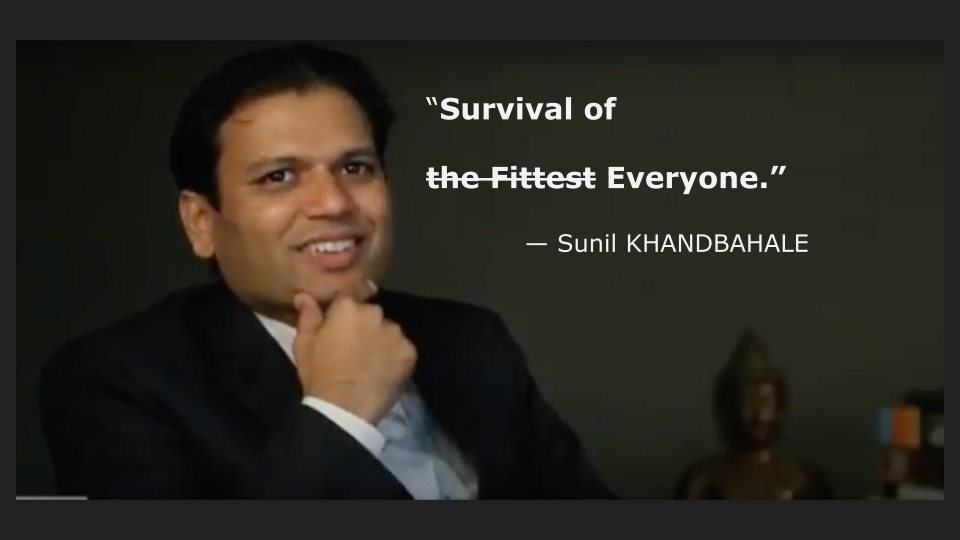
“Survival of Everyone”, Reclaiming Humanity Beyond “Survival of the Fittest”
— Sunil KHANDBAHALE
“Survival of the fittest” is one of the most quoted and most misunderstood phrases of our time.
Coined by philosopher Herbert Spencer in 1864 and later associated with Charles Darwin’s theory of natural selection, the phrase had a very specific scientific meaning. In evolutionary biology, fitness refers to an organism’s ability to adapt, survive, and reproduce in a given environment. It was never about brute strength, cruelty, or moral superiority. It was a descriptive observation of nature, not a prescription for human behavior.
And yet, somewhere along the way, we began using this phrase far beyond its original context.
Today, “survival of the fittest” is casually invoked in workplaces, classrooms, social circles, and even families to justify exclusion, indifference, and inequality. It is used to silence the vulnerable, shame those who struggle, and rationalize systems where only a few thrive while many are left behind.
That, to me, is not evolution.
That is abdication of humanity.
When Science Is Misused as Social Permission
Darwin spoke of species.
We speak of people.
That distinction matters.
Human societies are not ecosystems governed only by instinct. We are endowed with something rare in nature: conscious choice. We possess empathy, moral reasoning, and the ability to design systems that uplift rather than eliminate.
Even in the animal kingdom, we see care for the weak. Birds feed the smallest chick. Herds protect the injured. Packs slow down for the young. Nature itself is not as ruthless as we often portray it.
Then why should humans, gifted with greater intelligence and awareness, lower their moral bar below that of animals?
Using “survival of the fittest” to taunt a colleague, dismiss a struggling team member, or normalize toxic competition is not realism. It is convenience masquerading as wisdom.
What Leadership Taught Me: “No Fellow Left Behind”
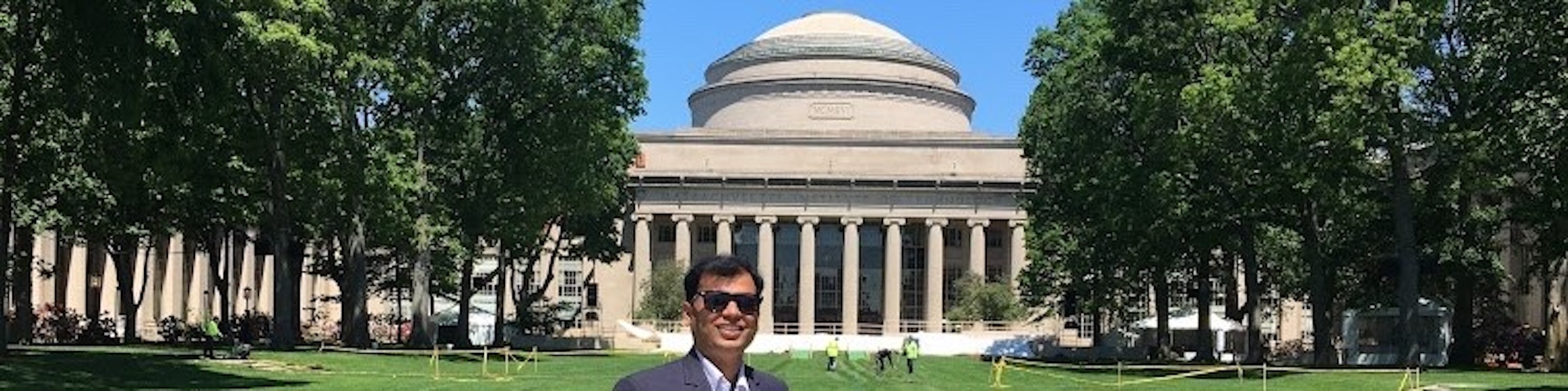
During my time as an MIT Sloan Fellow (SF’16), one phrase stayed with me deeply:
“No fellow left behind.”
It wasn’t a slogan. It was a value system.
It reminded us that leadership is not about outpacing others, it is about bringing people along. It taught us that teams win not when the strongest dominate, but when the collective rises. That learning environments flourish when inclusion replaces intimidation.
That single line quietly dismantles the misuse of “survival of the fittest.”
Because true leadership asks a different question:
How do we ensure everyone has a fair chance to grow?
Parenthood as the Purest Counterexample
Consider a family.
No parent ever says, “Let the weakest child figure it out—survival of the fittest.”
Parents instinctively do the opposite.
They protect the vulnerable child more carefully.
They empower without humiliating.
They support without labeling.
They ensure dignity without discrimination.
And they do this not because the child is less deserving but because the child is equally worthy.
If fairness and care define our smallest unit of society, why should they vanish in our organizations, institutions, or nations?
Equality Is Not Lowering the Bar, It Is Expanding the Floor
Supporting the weaker does not mean penalizing excellence.
Inclusion does not mean ignoring merit.
It means creating systems where no one is written off prematurely because of background, circumstance, language, health, gender, race, religion, or momentary inability.
True fitness in a human society is not about outcompeting others.
It is about enabling collective flourishing.
A world where only the “fittest” survive is fragile.
A world where everyone is supported to grow is resilient.
Vasudhaiva Kutumbakam: The World as One Family
Indian philosophy offers a timeless counterpoint:
Vasudhaiva Kutumbakam — the world is one family.
In a family, success is shared. Failure is absorbed together. Growth is mutual.
This worldview does not reject evolution, it transcends it. It acknowledges where we came from, while choosing consciously where we want to go.
In an age of inequality, burnout, climate crisis, and social fragmentation, the question is no longer who survives.
The real question is:
What kind of humanity do we want to become?
A New Thought for a New Time
I do not reject Darwin.
I reject the careless weaponization of his ideas against human dignity.
Nature may reward the fittest.
But humanity is measured by how we treat the weakest.
And that is why I choose to say:
“Survival is not of the fittest alone but of everyone.”
or simply
“Survival of Everyone.”
Because progress without compassion is not progress.
And evolution without ethics is regression.
If we truly want a thriving, healthy, prosperous world for families, organizations, societies, species, and the planet itself, then the future does not belong to the strongest.
It belongs to those who care enough to ensure no one is left behind.